Workshop: Genealogies of Corporate Morality
The Corporate Subjects project hosted the workshop “Genealogies of Corporate Morality: Approaching Business Ethics Through Intellectual History” at the University of St Andrews, bringing together scholars working on the intellectual history of corporate ethics (25-27 June 2025).
Where did ideas about corporate morality come from, and why does it matter? Business ethics, a field which has been expanding in Western scholarship since the 1970s, tends to prioritise a philosophical rather than a historical reading of past ethical thought. Although the works of ‘historical figures’ (Werhane et al, 2017) in philosophy have enriched modern analyses of corporate ethics, they tend to be read instrumentally – for their usefulness in addressing contemporary ethical questions – rather than historically, with the primary aim of reconstructing the past intellectual contexts to which these philosophers responded (Skinner, 2002; Hühn, 2018). Nonetheless, ethical responses to the modern corporation are increasingly informed by emerging research on the corporation’s intellectual history (e.g., Ciepley, 2023; Claassen, 2021; Gindis, 2020a; Harris, 2020; Ireland, 1999; Jessen, 2012; Logan, 2019; Mansell, 2024; Mansell and Sison, 2020; Phillips et al, 2020; Stern, 2023). Situating the history of corporations’ behaviour, purpose, rights and responsibilities in their intellectual contexts can reveal the ethical, economic, political and legal assumptions underpinning contemporary business ethics.
This historical turn enables us to explore the frameworks and limitations of a field of scholarship that still privileges certain canons and contexts, often foregrounded in Western ideas. Globally diverse genealogies of corporate morality can yield fresh approaches to moral and political questions today, including the public or private role of business (Ciepley, 2013), the changing framework of choices and constraints that business corporations face (Djelic and Etchanchu, 2017), and the interplay between corporate morality and other ethical and political ideas (Runciman, 1997; Fitzmaurice, 2022). For example, what is the history of thought about corporations’ environmental responsibilities (Pollman, 2024), businesses’ relationship to work and workers (Black, 2003) including the gender divisions that characterise work, and corporations’ implication in colonialism, primitive accumulation, imperial extraction, and counter-revolution (Stern, 2011; Wani, 2022)? How has intellectual debate shaped corporate law (Barkan, 2013; Gindis, 2020b; Kershaw, 2018), and what has been the influence of business forms on constitutional and political thought (Ciepley, 2017; Kubala, 2024)? Should we consider ideas about modern corporations as having an early modern, medieval, or even ancient genealogy (Duff, 1938; Kantorowicz, 1957; Tierney, 1955; Turner, 2016)? How should we critique universal histories of corporations and study non-western formations of corporate subjects (Birla, 2009)? Finally, why and how should ‘canonical’ political and economic thinkers, such as Plato, Aristotle, Aquinas, Smith, Kant, Marx, Nietzsche and Rawls, be approached by philosophers in business ethics (Dierksmeier, 2013; Hühn and Dierksmeier, 2016; Mejia, 2022; Mansell, 2013; Melé, 2016; Singer, 2015; Sison and Fontrodona, 2012; Smith and Dubbink, 2011; Worden, 2009)?
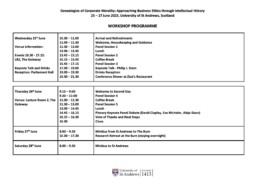
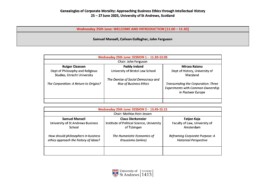
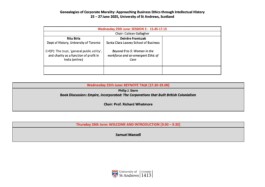
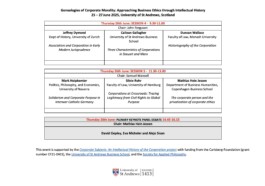
Workshop Programme
Links
Call for Abstracts: Link